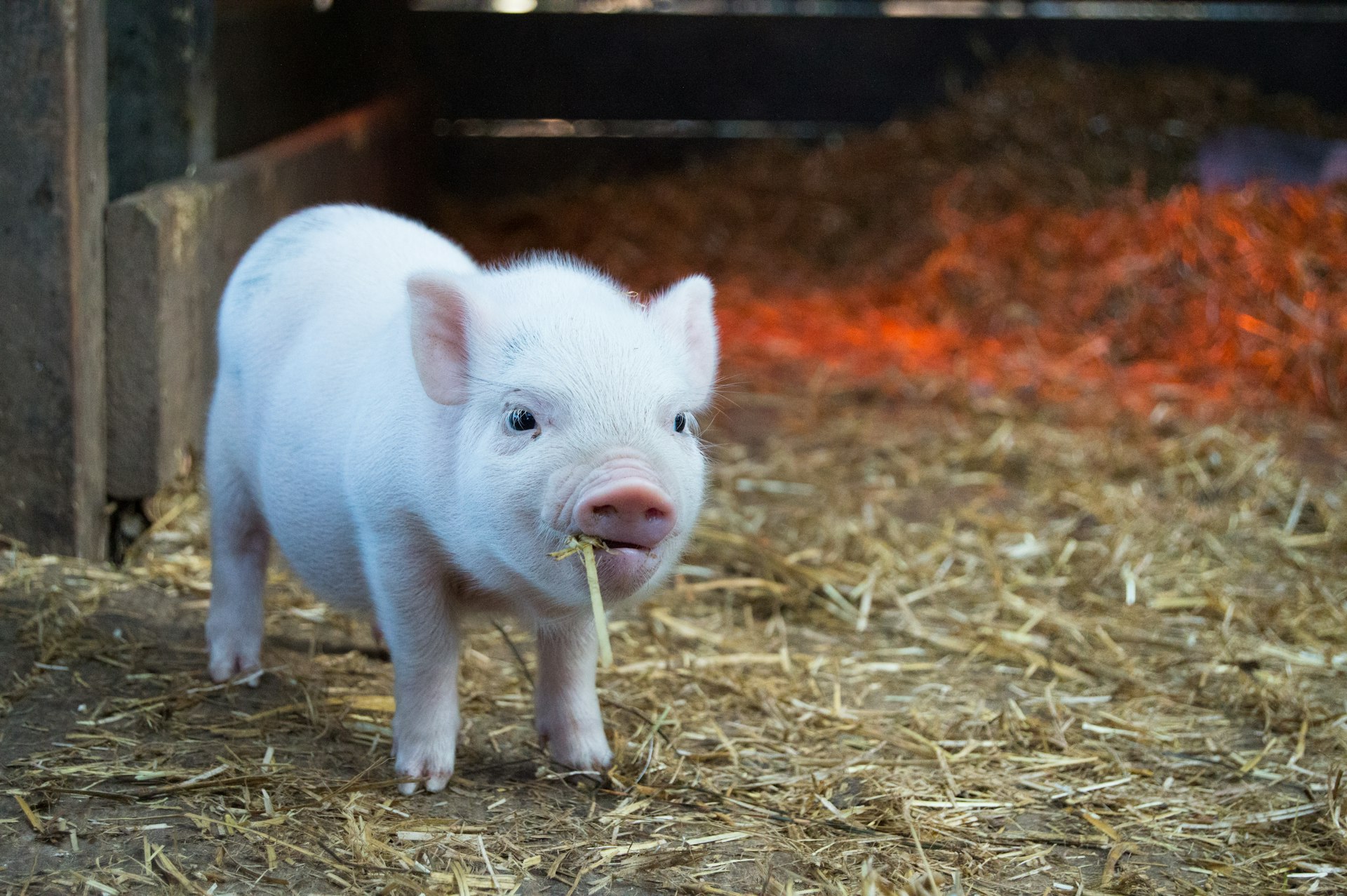
Take two animals. Both are young, roughly the same age. Both are intelligent enough to recognize their names, solve simple problems, and form social bonds. Both are capable of experiencing pain through identical neurological mechanisms, nociceptors firing, cortisol spiking, behavioral distress responses that any veterinarian would recognize immediately.
Castrate the first one without anesthesia, and you have committed a felony. In most states, you face prison time, substantial fines, and a permanent record as an animal abuser. Castrate the second one without anesthesia, and you have followed standard industry practice. No law has been broken. No regulatory body will investigate. No fine will be assessed.
The first animal is a puppy. The second is a piglet. The neurological capacity for suffering is the same. The legal treatment is not. The difference has nothing to do with biology, cognition, or any coherent ethical framework. It has to do with economic classification. One animal is categorized as a companion. The other is categorized as a production unit.
This distinction, the legal architecture that makes the same physical act a crime in one context and standard practice in another, is the foundation of American animal welfare law as it applies to farming. It is not an accident. It is not an oversight. It is the product of decades of deliberate legislative design, and it represents what may be the most effective regulatory capture in American law.
The common farming exemption
In between 28 and 36 states, the range reflects disagreement about how to classify ambiguous statutory language, animal cruelty statutes contain what is known as a common farming exemption.1 The exemption takes various forms, but the operative principle is consistent: practices that are customary in agriculture are excluded from the legal definition of animal cruelty.
Read that structure again. The law does not define cruelty based on the act itself, the infliction of pain, the deprivation of basic needs, the conditions of confinement. It defines cruelty based on whether the act is customary within the industry that performs it. The industry that has an economic interest in minimizing the cost of animal care is the same industry that determines whether its cost-minimizing practices constitute cruelty. The regulated entity writes its own regulations.
This is textbook regulatory capture, and it operates with unusual efficiency because it does not even require the industry to lobby a regulatory agency for favorable rulings. The exemption is structural. It is baked into the statute. As long as a practice is widespread within the industry, it is, by definition, not cruel. The standard tracks the industry’s behavior, not the animal’s experience.
The practical scope of this exemption is vast. Gestation crates that confine a 500-pound sow in a space so small she cannot turn around for the duration of her pregnancy, customary, therefore not cruel. Battery cages that give a laying hen less floor space than a standard sheet of paper for the entirety of her productive life, customary, therefore not cruel. Beak trimming without anesthesia, tail docking without anesthesia, dehorning without anesthesia, all customary, all exempt.
The exemption does not merely permit specific practices. It creates a self-adjusting legal standard that moves with the industry. If the industry adopts a new practice and it becomes widespread, the practice automatically falls within the exemption. The law does not need to be amended. The exemption expands to accommodate whatever the industry decides is normal.
The federal architecture of non-regulation
The common farming exemption operates at the state level. At the federal level, the legal architecture is, if anything, more favorable to industry.
The Animal Welfare Act, the primary federal statute governing the treatment of animals, explicitly excludes farm animals used in agriculture.2 The exclusion is not ambiguous. The statute defines “animal” for regulatory purposes and then carves out farm animals, along with rats, mice, and birds, from the definition. The animals that constitute the overwhelming majority of human-animal interactions in the United States, the roughly 10 billion land animals raised and slaughtered annually for food,3 are simply not covered by the primary federal animal welfare law.
The Humane Methods of Slaughter Act, enacted in 1958 and amended in 1978, does cover farm animals, but only at the moment of slaughter, and not all of them. The Act requires that livestock be rendered insensible to pain before slaughter. It excludes poultry.4 Since poultry, chickens and turkeys, constitute approximately 98 percent of all land animals slaughtered in the United States, the Humane Methods of Slaughter Act covers roughly 2 percent of the animals it is ostensibly designed to protect.
The exclusion of poultry is not based on any biological argument that chickens experience slaughter differently than cattle. It is a legislative artifact of the poultry industry’s political influence at the time the Act was amended. The exclusion has been maintained for nearly fifty years through the same mechanism: the industry opposes its removal, and the political cost of confronting the industry exceeds the political benefit of protecting animals that most voters never see.
The result is a federal regulatory framework in which the vast majority of farmed animals receive no meaningful legal protection at any point in their lives. State cruelty laws, which might theoretically fill this gap, are neutralized by common farming exemptions. The animal occupies a legal category in which the definition of acceptable treatment is determined entirely by the economic interests of the entity that controls the animal.
Ninety-nine percent
To understand the scale of what this legal architecture permits, it helps to look at the physical reality it governs.
Ninety-nine percent of farmed animals in the United States live on factory farms,5 concentrated animal feeding operations (CAFOs) where animals are raised at industrial densities in enclosed facilities designed to maximize output per square foot. This is not a contested statistic. It is derived from USDA census data cross-referenced with facility size classifications. The family farm that most Americans picture when they think about where their food comes from accounts for a vanishingly small fraction of actual production.
The conditions inside these facilities vary by species and operation, but certain features are structural. Confinement systems are designed around the minimum space requirements needed to keep animals alive and growing, not around any measure of the animal’s behavioral or psychological needs. Breeding sows spend their pregnancies in gestation crates measuring approximately two feet by seven feet. Laying hens in conventional cage systems are allocated 67 to 76 square inches of space, less than the area of a standard letter-size page. Broiler chickens raised for meat are kept in houses of 20,000 to 30,000 birds, with stocking densities that leave each bird less than one square foot of floor space at market weight.
These conditions produce predictable behavioral and physiological consequences. Hens in battery cages exhibit stereotypic behaviors, repetitive, purposeless movements that are recognized indicators of psychological distress in every species in which they have been studied. Sows in gestation crates develop bar-biting behaviors, exhibit elevated cortisol levels, and show measurable bone density loss from inability to move. Broiler chickens, bred for growth rates that their skeletal systems cannot support, frequently develop leg deformities that make standing painful. A substantial percentage of broilers at market weight are functionally lame.
These outcomes are not side effects of an otherwise functional system. They are the system. The economics of industrial animal agriculture depend on density, speed, and the externalization of costs that would be incurred by providing animals with conditions adequate to their basic biological needs. The common farming exemption ensures that these conditions remain outside the reach of animal cruelty law.
The result is a gap between public perception and industrial reality that is almost difficult to overstate. Surveys consistently show that approximately 75 percent of Americans believe they purchase products from humanely treated animals.6 The actual percentage of farmed animals living in conditions that most Americans would recognize as humane, if they could see them, is closer to 1 percent.
The enforcement collapse
Even within the narrow legal framework that does exist, enforcement has deteriorated to a point that renders the remaining protections largely theoretical.
The USDA’s Food Safety and Inspection Service (FSIS) is responsible for enforcing the Humane Methods of Slaughter Act in slaughter facilities. The agency has approximately 115 inspectors assigned to humane handling oversight, a number that has declined by more than 33 percent in recent years.7 These inspectors are responsible for monitoring all licensed slaughter facilities in the United States, a task that is physically impossible at current staffing levels.
The enforcement tools available to these inspectors have also been constrained. In 2024, the Supreme Court’s decision in SEC v. Jarkesy limited the ability of federal agencies to pursue enforcement through administrative proceedings, requiring many actions to go through federal court.8 The practical effect on USDA enforcement has been significant. In the 2024-2025 period, the USDA issued zero fines for humane handling violations. Not a single financial penalty. The agency’s enforcement actions during this period consisted almost entirely of non-binding warnings, letters that document a violation but carry no legal consequence. Ninety-one percent of all USDA enforcement actions are now non-binding warnings.9
The last criminal prosecution for inhumane slaughter in the United States occurred in 2007.10 In the nearly two decades since, no individual and no corporation has faced criminal charges for violating the Humane Methods of Slaughter Act, despite documented violations at numerous facilities. The statute exists. The enforcement apparatus that would give it meaning does not.
The inspector workforce reduction compounds this problem through a familiar mechanism. Fewer inspectors means fewer inspections means fewer documented violations means lower reported violation rates. The decline in enforcement activity creates the statistical appearance of improved compliance. The data shows fewer violations not because conditions have improved, but because the measurement system has been dismantled.
There is a term for this in regulatory theory: deregulation by defunding. You do not need to repeal a law if you can eliminate the capacity to enforce it. The law remains on the books, available as a rhetorical prop, evidence that the system takes animal welfare seriously, while carrying no operational weight.
The information shield
A regulatory system this permissive would seem vulnerable to public pressure. If voters could see the conditions inside concentrated animal feeding operations, the political calculus might shift. The industry recognized this vulnerability and addressed it directly.
Ag-gag laws, statutes that criminalize unauthorized recording or documentation inside agricultural facilities, have been enacted in various forms across multiple states. The laws take different approaches. Some criminalize the act of gaining employment at a facility under false pretenses for the purpose of conducting an investigation. Others criminalize the recording itself. Some require that any evidence of animal cruelty obtained through employment be reported to authorities within a specified timeframe, 24 or 48 hours, which prevents undercover investigators from documenting patterns of systemic abuse that only become visible over weeks or months.
The constitutional status of ag-gag laws is unsettled. The Fourth Circuit Court of Appeals has ruled that certain ag-gag provisions violate the First Amendment. The Eighth Circuit has upheld similar provisions.11 The circuit split means that the legality of documenting conditions in animal agriculture depends on geography, an investigation that is constitutionally protected in one state may be a criminal act in the neighboring state.
The practical effect, regardless of the legal nuances, is a chilling effect on investigation and documentation. Undercover investigations by animal welfare organizations have historically been the primary mechanism through which the public learns about conditions inside factory farms. The facilities are private property. They are not open to the public. Regulatory inspectors, where they exist, are focused on food safety, not animal welfare. Without undercover investigation, the only information available about conditions inside these facilities comes from the industry itself.
This information asymmetry is the final structural element in the regulatory capture architecture. The common farming exemption removes legal liability. The federal exclusions eliminate regulatory oversight. Enforcement defunding neutralizes the protections that remain. Ag-gag laws prevent independent documentation. At each layer, the industry’s control over the information environment increases.
The result is a system in which 10 billion animals per year live and die under conditions that the public cannot see, the law does not regulate, and enforcement mechanisms do not reach. The system is not broken. It is functioning precisely as it was designed to function.
What transparency reveals
Despite the ag-gag architecture, information does occasionally reach the public. When it does, the response pattern is instructive.
Every major undercover investigation that has been made public over the past two decades has produced the same sequence: graphic footage of conditions that shock viewers, a burst of media coverage, public outrage, industry statements that the documented conditions represent isolated deviations from normal practice, a brief investigation that results in no criminal charges, and a return to equilibrium. The cycle has repeated often enough to be predictable.
The industry’s defense, that documented abuses are aberrant, not systemic, is difficult to reconcile with the structural incentives of the system. When animals are economic inputs, when production facilities operate at maximum density, when labor is low-wage and high-turnover, when regulatory oversight is absent, and when the legal definition of cruelty excludes standard practice, the conditions for systemic abuse are not anomalous. They are inherent.
The footage that periodically surfaces, workers striking animals, animals with untreated injuries and infections, animals unable to stand or walk, animals that have died and been left among the living, documents not the failure of the system but its normal operating parameters under conditions of zero accountability. Remove the cameras, and the conditions remain. The investigations reveal what is there. They do not create it.
Proposition 12 and the proof of concept
Against this backdrop, California’s Proposition 12 represents something unusual: a successful challenge to the structural architecture of non-regulation.
Passed by California voters in 2018 and upheld by the Supreme Court in a 5-4 decision in National Pork Producers Council v. Ross in 2023,12 Proposition 12 establishes minimum space requirements for breeding pigs, veal calves, and egg-laying hens, and prohibits the sale in California of products from animals confined below those standards, regardless of where the animals were raised. The law does not eliminate confinement agriculture. It establishes a floor, a minimum below which conditions cannot legally fall for products sold in the state.
The industry’s response to Proposition 12 was vigorous and revealing. The legal challenge, which reached the Supreme Court, argued that California was impermissibly regulating out-of-state commerce by imposing conditions on products from other states. The Court rejected this argument, finding that California has the authority to regulate the products sold within its borders, including by imposing production-standard requirements.
The significance of Proposition 12 is not its specific requirements, which are modest by international standards. The significance is structural. It demonstrates that the regulatory capture architecture of common farming exemptions can be circumvented through direct democratic action, ballot initiatives that bypass the legislative process where industry lobbying is most effective. It establishes that state-level product standards can create regulatory effects that cross state lines, incentivizing producers nationwide to meet California’s requirements in order to access the largest consumer market in the country.
The pattern of Proposition 12 is consistent with broader public opinion data. When Americans are asked directly about specific practices in industrial animal agriculture, gestation crates, battery cages, slaughter methods, large majorities express opposition. Eighty-eight percent of Americans want wild horses protected.13 Eighty to eighty-three percent oppose horse slaughter. These numbers reflect a public that holds strong views about animal treatment but lacks the informational access and political channels to translate those views into regulation within the conventional legislative process.
The ballot initiative pathway, Proposition 12 in California, Question 3 in Massachusetts, similar measures in other states, routes around the structural barriers of legislative regulatory capture. It places the question directly before voters who, when given specific information about specific practices, consistently choose higher welfare standards. The industry’s opposition to these initiatives is itself evidence that the measures represent a meaningful constraint. Industries do not spend millions of dollars opposing regulations that have no effect.
The anatomy of regulatory capture
The animal welfare regulatory structure is worth examining not only for what it reveals about animal agriculture, but for what it reveals about regulatory capture as a general phenomenon.
Effective regulatory capture requires several structural elements, and the agricultural sector has assembled all of them. First, definitional control: the ability to define the boundaries of the problem so that the industry’s conduct falls outside the scope of regulation. The common farming exemption achieves this by defining cruelty in terms of industry practice rather than animal experience. Second, jurisdictional fragmentation: the division of regulatory authority across federal and state levels in ways that create gaps. The Animal Welfare Act’s exclusion of farm animals, combined with the patchwork of state exemptions, ensures that no single regulatory body has comprehensive authority. Third, enforcement neutralization: the systematic reduction of enforcement capacity to the point where existing regulations carry no practical consequence. The inspector reductions, the shift to non-binding warnings, and the absence of criminal prosecution achieve this. Fourth, information control: the ability to prevent the regulated conditions from becoming publicly visible. Ag-gag laws and the closed nature of industrial facilities achieve this.
What makes this architecture unusually robust is that each element reinforces the others. The definitional exclusion means there is nothing for enforcers to enforce. The enforcement deficit means violations, even if they occur within the narrow remaining legal framework, carry no consequence. The information control prevents the public from learning about conditions that might generate political pressure for reform. And the political influence that created these structures in the first place is sustained by the economic scale of an industry that generates billions in revenue annually.
This is not a conspiracy. It does not require secret coordination or malicious intent by any individual actor. It is an emergent property of a system in which a concentrated economic interest, the animal agriculture industry, interacts with a diffuse public interest, the humane treatment of animals, within legislative and regulatory structures that systematically favor concentrated interests. The outcome is predictable from the structure. It requires no explanation beyond the incentives.
The gap between values and systems
The most striking feature of the American animal welfare landscape is not the severity of conditions in industrial animal agriculture. Other countries operate similar systems. What is striking is the magnitude of the gap between the values Americans express and the system their legal framework permits.
Americans are, by any available measure, a nation that cares about animals. Household pet spending exceeds $140 billion annually. Animal cruelty cases involving companion animals generate intense public outrage and severe legal penalties. The cultural status of dogs and cats in American life is functionally that of family members. This concern is genuine and broadly held.
The same population that spends $140 billion on pet care consumes the products of a system in which 10 billion land animals per year live under conditions that, if applied to dogs and cats, would constitute serious criminal offenses in every state. The gap is not a contradiction in values. It is a product of information asymmetry, legal architecture, and the systematic separation of the consumer from the conditions of production.
The common farming exemption does not merely permit industrial animal agriculture. It makes it invisible. By defining standard practice as inherently non-cruel, the legal framework removes the conceptual category through which the public might evaluate what is happening. If the law says it is not cruelty, the cognitive shortcut is to believe that it is not cruel. The legal fiction becomes a perceptual filter.
This is the deepest function of regulatory capture, not merely to prevent regulation, but to shape the frame through which the regulated activity is understood. The common farming exemption does not just protect the industry from prosecution. It protects the industry from the public’s own moral intuitions by creating a legal architecture that says, implicitly but continuously: this is normal, this is accepted, this is not the kind of thing that cruelty laws are about.
What the structure reveals
The animal welfare regulatory framework is a case study in how legal architecture can sustain outcomes that contradict majority preferences over extended periods. The mechanisms are not unique to this domain. Definitional control, jurisdictional fragmentation, enforcement neutralization, and information restriction are present, in various combinations, across numerous areas of American regulatory policy. What distinguishes the animal welfare case is the clarity with which the architecture is visible once you know where to look.
Common farming exemptions delegate the definition of acceptable conduct to the regulated industry. Federal statutes exclude the majority of affected animals from coverage. Enforcement agencies lack the resources to apply the protections that remain. Ag-gag laws criminalize the documentation that might generate public pressure for reform. And ballot initiatives demonstrate, each time they are deployed, that the public supports substantially higher standards than the legislative system produces.
The implication is not that reform is impossible. Proposition 12 demonstrates otherwise. The implication is that reform within the conventional legislative process will remain structurally disadvantaged as long as the industry maintains its current level of influence over the committees, agencies, and state legislatures that shape agricultural regulation. The pathway that has produced results, direct democratic action through ballot initiatives, combined with consumer market pressure and corporate welfare commitments, routes around rather than through the captured regulatory apparatus.
This is not a comfortable conclusion. Direct democracy is an imperfect tool. Ballot initiatives are expensive, slow, and limited to states that permit them. Corporate welfare commitments are voluntary and inconsistently enforced. Consumer pressure is constrained by the same information asymmetry that the industry works to maintain.
But the alternative, relying on the legislative and regulatory systems that the industry has spent decades constructing to serve its interests, has produced the current outcome: a legal framework in which the entity with the greatest economic interest in minimizing the cost of animal care defines the legal standard for what constitutes care. A framework in which 10 billion animals per year live outside the reach of cruelty law. A framework that is working exactly as designed.
The question embedded in the common farming exemption is not whether animals suffer. The veterinary and behavioral science on that point is settled. The question is who gets to decide whether that suffering counts. For between 28 and 36 states, the answer is the industry that profits from it.
That is not a failure of the system. It is the system. And it will remain the system until the structures that sustain it are changed by the only force the architecture cannot fully contain: an informed public acting through the channels the industry does not control.
Footnotes
-
Animal Legal Defense Fund, state animal protection law rankings and common farming exemption analysis. ↩
-
Animal Welfare Act, 7 U.S.C. SS 2132 (definition of “animal” excluding farm animals). ↩
-
USDA, National Agricultural Statistics Service, livestock slaughter data. ↩
-
Humane Methods of Slaughter Act, 7 U.S.C. SS 1902 (poultry exclusion). ↩
-
Sentience Institute analysis of USDA Census of Agriculture data; EPA CAFO classifications. ↩
-
Sentience Institute and Ipsos, survey of American attitudes toward animal farming, 2017. ↩
-
USDA APHIS Animal Care, inspector staffing data, March 2025. ↩
-
SEC v. Jarkesy, 603 U.S. ___ (2024). ↩
-
USDA APHIS enforcement action data, 2024-2025. ↩
-
USDA enforcement records; Humane Methods of Slaughter Act prosecution history. ↩
-
Fourth Circuit (striking down ag-gag provisions) vs. Eighth Circuit (upholding Iowa ag-gag statutes, January 2024). ↩
-
National Pork Producers Council v. Ross, 598 U.S. 356 (2023). ↩
-
Public Policy Polling and American Wild Horse Campaign, national survey data. ↩