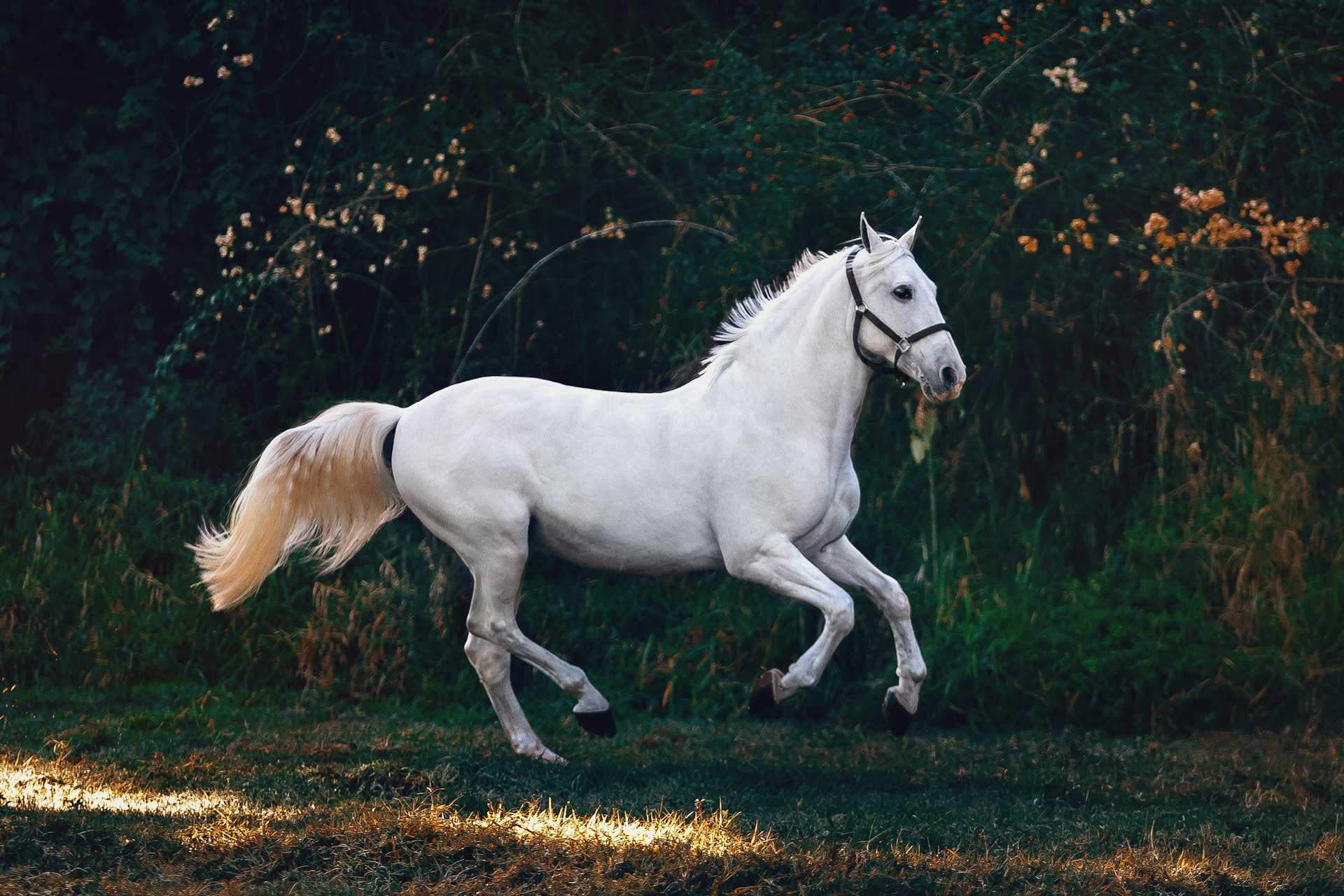
In March 2025, the Bureau of Land Management reported that approximately 73,000 wild horses and burros roamed free on federal land in the American West.1 In holding facilities, corrals, and off-range pastures operated by the federal government or its contractors, another 65,000 animals stood in pens, eating government-purchased hay, receiving government-funded veterinary care, and costing the American taxpayer roughly $101.4 million per year.23
There are now nearly as many wild horses in government warehouses as there are on the range. The holding population has been growing for years, because the government removes horses from the range faster than it can place them into private care through its adoption program, and federal law prohibits the sale of captured horses for slaughter. The animals enter holding. They do not leave. They live out their natural lifespans, fifteen to twenty-five years, at public expense. The per-horse lifetime cost of off-range holding ranges from $15,000 to $48,000, depending on the type of facility and the horse’s age at capture.4
The total annual cost of the Bureau of Land Management’s Wild Horse and Burro Program is approximately $142 million.2 That figure has grown from $20.4 million in fiscal year 2000, an increase of roughly 600 percent in twenty-five years.5 Two-thirds of the budget goes to holding costs. Less than 4 percent goes to fertility control.6
In 2013, the National Academy of Sciences reviewed the program and concluded that the BLM’s approach was “expensive and unproductive.” The review recommended a fundamental shift from removal-based management to fertility control. The BLM acknowledged the recommendation. More than a decade later, the program’s structure has not fundamentally changed.
This is a story about horses. It is also a story about how federal programs, once established, develop constituencies that benefit from their continuation regardless of whether they achieve their stated purpose. The wild horse program does not work. It was not designed to work. It was designed to manage a political conflict between the livestock industry and the American public, and it performs that function with considerable, if expensive, efficiency.
The origin
Wild horses have lived on the North American landscape since the Spanish colonial period, descendants of domestic stock that escaped or was released over centuries. Their legal status was, for most of American history, ambiguous. They were considered feral livestock, ownerless property, available for capture by anyone who could catch them. In the mid-twentieth century, they were routinely rounded up by aircraft and trucks, often with considerable brutality, and sold for slaughter. The meat was processed into pet food and fertilizer.
The person who changed this was Velma Bronn Johnston, a Nevada secretary who became known as “Wild Horse Annie.”7 Johnston witnessed a truckload of bleeding, injured horses being transported from a roundup in 1950 and spent the next two decades campaigning for their protection. Her effort was, by the standards of mid-century environmental politics, remarkably effective. In 1959, Congress passed the Wild Horse Annie Act, which prohibited the use of motorized vehicles to capture wild horses on public land. In 1971, Congress passed the Wild Free-Roaming Horses and Burros Act, which declared wild horses and burros to be “living symbols of the historic and pioneer spirit of the West” and placed them under federal protection, managed by the Bureau of Land Management and the U.S. Forest Service.
The 1971 Act was passed with near-unanimous support. It reflected genuine public sentiment. Americans liked wild horses. They wanted them protected. Polls conducted decades later continue to show this: an 88 percent majority of Americans support the protection of wild horses on public land.8
The Act also contained the structural conditions for everything that followed. It tasked the BLM with maintaining wild horse populations at “appropriate management levels” (AMLs), determined on a herd-by-herd basis. It authorized the BLM to remove “excess” horses from the range. And it required that removed horses be made available for adoption or, if unadoptable, maintained by the government. The Act did not define how appropriate management levels would be determined, who would determine them, or what criteria would govern the calculation. These decisions were left to the BLM, an agency whose primary constituency, then and now, is the livestock industry.
The numbers that define the conflict
The Bureau of Land Management administers approximately 245 million acres of federal land, most of it in the Western states. Of that total, approximately 155 million acres are leased to private ranchers for livestock grazing. Wild horses are managed on approximately 25 million acres, designated as Herd Management Areas.
On those 155 million acres, roughly 1.5 million cattle graze under federal permits.9 On the 25 million acres of Herd Management Areas, approximately 73,000 wild horses and burros roam free. The ratio is approximately 28 cattle for every horse on public land.
The grazing permits are issued at a fee of $1.35 per animal unit month (AUM), the amount of forage required to sustain one cow and calf for one month.10 The comparable rate on private land averages approximately $23.40 per AUM. The federal fee is roughly 6 percent of the market rate. This discount, maintained by Congress under pressure from the livestock industry, represents a subsidy of several hundred million dollars per year to ranchers who graze cattle on public land.
The relationship between cattle and horses on public land is the key to understanding the wild horse program. The BLM sets appropriate management levels for horse herds on each Herd Management Area. When horse populations exceed those levels, the BLM conducts helicopter roundups to remove the excess animals. The removed horses are transported to holding facilities. The range is then available for its primary permitted use: cattle grazing.
A 2024 analysis by Public Employees for Environmental Responsibility (PEER) examined BLM rangeland health assessments and found that fewer than 1 percent of grazing allotments that failed to meet land health standards attributed the failure to wild horses. By contrast, 33 percent attributed the failure to livestock grazing.11 The data suggest that cattle, not horses, are the primary source of rangeland degradation on public land. The management program, however, is designed almost exclusively to control horse numbers.
Eighty-nine percent of contract funds in the BLM’s wild horse program flow to livestock operators, who receive contracts for off-range holding and pasture care of removed horses.12 The same industry that benefits from the removal of horses from the range also benefits financially from their confinement after removal. The roundup-and-hold model creates a self-reinforcing economic loop: horses are removed to make room for cattle; the removed horses are placed in holding facilities operated by cattle ranchers; the ranchers are paid from the same federal budget that funds the removal operations.
The science that is being ignored
The National Academy of Sciences issued its review of the BLM Wild Horse and Burro Program in 2013. The report was comprehensive, peer-reviewed, and unambiguous in its conclusions.
The NAS found that the BLM’s primary management tool, helicopter roundups followed by off-range holding, was not only expensive but counterproductive. The report documented a phenomenon that wildlife biologists had understood for decades: compensatory reproduction.13 When horses are removed from a herd, the reduced population density leads to improved forage availability for the remaining animals. Better nutrition leads to higher fertility rates, earlier sexual maturity, and improved foal survival. The population rebounds, often rapidly, toward its previous level.
In other words, the roundups stimulate the very population growth they are intended to control. The BLM removes horses. The remaining horses reproduce faster. The population recovers. The BLM conducts another roundup. The cycle repeats, and with each cycle, the holding population grows and the budget increases.
The NAS recommended that the BLM shift its primary management strategy from removal to fertility control, specifically the use of the porcine zona pellucida (PZP) immunocontraceptive vaccine. PZP is a well-studied, field-tested fertility control agent that has been used in wildlife management for decades. It costs approximately $30 per dose.14 It is 90 to 97 percent effective at preventing pregnancy. It does not require the capture and permanent removal of animals from the range. It is reversible. It has no significant behavioral side effects. It can be delivered via dart, without physical restraint of the animal.
The evidence for PZP’s effectiveness is not theoretical. It has been demonstrated in practice, in multiple locations, with peer-reviewed results. The Virginia Range herd in Nevada, managed with PZP by the American Wild Horse Campaign in collaboration with state wildlife authorities, achieved a 66 percent reduction in foaling rates within four years of program initiation.15 The population stabilized. The horses remained on the range. No helicopter roundups were required. No holding facilities were needed.
The per-dose cost of PZP is $30. The per-horse lifetime cost of off-range holding is $15,000 to $48,000. The arithmetic is not complicated. Treating a mare with PZP once a year costs roughly $30 to $60, depending on delivery method. Removing that mare from the range and holding her for twenty years costs $15,000 at a minimum. The cost ratio is approximately 250 to 1 in favor of fertility control.
The implementation gap
If the science is clear and the economics are favorable, the obvious question is why the BLM has not adopted fertility control as its primary management tool.
The numbers tell part of the story. In fiscal year 2025, the BLM treated 921 mares with fertility control vaccines.16 To stabilize wild horse populations across all Herd Management Areas, scientists estimate that 18,750 to 22,500 mares would need to be treated annually. The current treatment rate is roughly 4 to 5 percent of what is needed. Less than 4 percent of the program’s budget is allocated to fertility control.
The BLM has offered various explanations for this gap. Darting free-roaming horses is logistically challenging. Not all herds are accessible. Not all mares can be individually identified for treatment tracking. These are real constraints, but they are logistical problems, the kind that federal agencies solve routinely when they are given the budget and the mandate to do so. The BLM has the budget. It spends $142 million per year. It simply allocates that budget predominantly to roundups and holding rather than to the approach that science recommends.
The mandate question is more revealing. The BLM’s advisory board, the Wild Horse and Burro Advisory Board, includes representatives from the livestock industry, wildlife management agencies, veterinary science, and advocacy organizations. The board’s recommendations have historically favored the roundup-and-hold approach. The livestock industry representatives on the board have a direct economic interest in the continued removal of horses from the range, both because removal reduces competition for forage and because holding contracts provide revenue to ranchers. The advisory structure amplifies the preferences of the industry that benefits most from the current system.
Congress plays a reinforcing role. Western-state legislators, many of whom depend on livestock industry support, have consistently funded the roundup-and-hold model while resisting efforts to redirect funds toward fertility control. The politics of Western public land management are dominated by a relatively small number of interests: livestock, mining, and energy. Wild horses do not have a lobby. They have public sympathy, which is powerful in polls but less powerful in appropriations committees.
The adoption pipeline and its collapse
The BLM’s adoption program was designed to be the release valve for the holding system. Removed horses would be offered for adoption by private individuals, reducing the holding population and the associated costs. For years, the program operated with modest success, placing several thousand horses per year into private homes.
To increase adoption rates, the BLM created the Adoption Incentive Program (AIP), which offered $1,000 to anyone who adopted a wild horse and maintained it for one year. The program increased adoption numbers significantly. It also created a problem.
Reports emerged that some adopters were acquiring horses in bulk, collecting the incentive payments, and then selling the horses to slaughter buyers, often through intermediary sales that obscured the transaction chain. The horses passed through the adoption pipeline and ended up at the same destination the 1971 Act was designed to prevent.
In March 2025, a U.S. District Court in Colorado struck down key elements of the Adoption Incentive Program, finding that the BLM had failed to implement adequate safeguards to prevent adopted horses from being sold for slaughter.17 The ruling effectively shut down the primary mechanism the BLM had been using to reduce its holding population.
The decision left the agency in a difficult position. The holding population continues to grow. The adoption pipeline has been restricted. The budget continues to be consumed by holding costs. And the fertility control program that could reduce the need for both roundups and holding remains funded at a fraction of the level needed to be effective.
What the horses actually do
The policy debate over wild horses has been conducted almost entirely in the language of resource management: forage allocation, carrying capacity, rangeland condition, and population targets. The horses are discussed as a management problem to be solved, a number to be reduced to a target. This framing omits something important.
Wild horses are not merely a cost to be managed. They are ecological actors with measurable effects on the landscapes they inhabit, and some of those effects are beneficial.
A 2021 study published in Science by researchers at Erick Lundgren’s team documented that wild horses (and wild burros) dig wells in desert environments, excavating through sand and gravel to reach subsurface water.18 These wells, sometimes more than a meter deep, provide water access to at least 57 other species, including birds, small mammals, and other wildlife that would otherwise have no access to water in arid conditions. The wells persist for weeks or months after being dug, functioning as small-scale water sources that enhance local biodiversity.
The finding is not unique. Ecologists have increasingly recognized that large herbivores, including horses, play functional roles in the ecosystems they inhabit. They create trails that serve as firebreaks. Their grazing patterns can promote vegetation diversity by preventing any single plant species from dominating. Their hoof action can break up soil crusts and improve water infiltration. These ecological contributions do not prove that any given horse population is at an appropriate density, but they complicate the narrative that horses are purely a problem to be eliminated from the landscape.
The ecological role of horses is particularly striking when compared to the ecological impact of the cattle that outnumber them 28 to 1 on the same public lands. Cattle tend to concentrate along waterways, degrading riparian habitat. Their selective grazing patterns can reduce plant diversity. Their waste contributes to water quality degradation. These impacts are well documented in rangeland science. Yet the management system is designed to remove horses and accommodate cattle, not the reverse.
The budget as a map of priorities
The wild horse program’s budget is a nearly perfect map of its actual priorities, which are not the priorities its authorizing legislation would suggest.
In fiscal year 2024, the BLM spent approximately $101.4 million on off-range holding, 66 percent of the program budget.3 It spent tens of millions more on gather operations (helicopter roundups). It spent less than 4 percent on fertility control. The budget has grown from $20.4 million in fiscal year 2000 to $142 million in fiscal year 2025, a 600 percent increase.5 During that same period, the holding population has grown from roughly 9,000 animals to 65,000. The on-range population has grown from roughly 37,000 to 73,000.
The program is spending seven times more money and achieving worse outcomes by every metric it uses to measure its own performance. The on-range population is higher. The holding population is higher. The total cost is higher. The program’s own data demonstrate that its approach is not working.
This would normally be the point at which a federal program faces serious scrutiny. In most areas of federal spending, a 600 percent budget increase accompanied by deteriorating outcomes would trigger congressional investigation, programmatic review, and demands for reform. The wild horse program has faced periodic criticism but no structural reform, because the program’s failure, measured by its own stated objectives, is consistent with the interests of its most powerful constituency. The livestock industry benefits from continued roundups (which remove horses from grazing land) and from continued holding (which provides contract revenue). A program that spent $30 per mare on fertility control and stabilized populations on the range would achieve the program’s stated objectives but eliminate the economic flows that sustain its political support.
The honest answer
The wild horse program is not failing. It is succeeding at something other than what it claims to be doing.
The stated purpose of the program is to maintain healthy wild horse populations on healthy rangelands. If this were the actual purpose, the program would have adopted fertility control as its primary management tool years ago. The science supports it. The economics support it. The precedent exists. The NAS recommended it in 2013. Peer-reviewed field trials have demonstrated its effectiveness. The cost comparison is not close.
The actual function of the program is to manage the political tension between public affection for wild horses (88 percent of Americans want them protected) and the livestock industry’s demand for unrestricted access to public grazing land (1.5 million cattle on 155 million acres at 6 percent of market-rate fees). The roundup-and-hold model serves this function by removing horses from the range (satisfying the livestock industry) while keeping them alive in holding (satisfying the public). The system is expensive, growing more expensive each year, and fundamentally unsustainable. But it distributes costs (to taxpayers) and benefits (to the livestock industry) in a way that is politically stable.
The honest answer to the question posed by the program’s escalating costs is that the money is not being spent to manage wild horses. It is being spent to avoid the political conflict that would result from either of the two approaches that would actually solve the problem: large-scale fertility control (which the livestock industry opposes because it would keep horses on the range) or significant reduction of livestock grazing on public land (which the livestock industry opposes for obvious reasons).
The $142 million annual cost is not a management expense. It is the price of political avoidance.
What would change look like
The elements of a functional wild horse management program are not difficult to describe. They have been described, in detail, by the National Academy of Sciences, by wildlife veterinarians, by rangeland ecologists, and by the BLM’s own scientific advisors.
First, fertility control would become the primary management tool. PZP and GonaCon (a longer-lasting immunocontraceptive) would be deployed across all Herd Management Areas at the scale needed to stabilize populations: 18,750 to 22,500 mares per year, compared to the current 921. The budget reallocation required is straightforward. Treating 20,000 mares at $60 per treatment (including delivery costs) would cost approximately $1.2 million per year. The current holding budget is $101.4 million. Even a modest reallocation would fund a comprehensive fertility control program many times over.
Second, the holding population would be gradually reduced through natural attrition, adoption reform, and expanded sanctuary partnerships. No additional horses would be added to holding once on-range populations were stabilized through fertility control. Over fifteen to twenty years, the holding population would decline as animals reached the end of their natural lifespans. The associated costs would decline with it.
Third, grazing fees on public land would be adjusted toward market rates. The current fee of $1.35 per AUM, compared to the $23.40 private market rate, represents a subsidy that artificially inflates demand for public grazing and creates the political pressure to remove horses.10 Raising the fee to even a fraction of the market rate would generate revenue that could fund range improvement and reduce the intensity of the competition narrative between cattle and horses.
Fourth, appropriate management levels for horse herds would be recalculated using current science rather than the decades-old estimates that many AMLs are based on. Several herds are managed to AMLs that were set in the 1970s and have never been updated to reflect current rangeland conditions, water availability, or ecological understanding.
None of these changes would be revolutionary. None would require new legislation. The BLM has the existing authority to implement fertility control, adjust management priorities, and reallocate its budget. What it lacks is the political space to act against the preferences of the livestock industry, which benefits from the current system’s dysfunction.
The question
The Bureau of Land Management will spend $142 million this year on a program that the National Academy of Sciences has called expensive and unproductive. It will conduct helicopter roundups that, by stimulating compensatory reproduction, will increase the population growth rate they are intended to reduce. It will add thousands of horses to a holding system that already costs two-thirds of the program budget. It will treat fewer than a thousand mares with a fertility control vaccine that costs $30 per dose and works with 90 to 97 percent efficacy. It will lease 155 million acres of public land for cattle grazing at 6 percent of market rate. It will spend more warehousing horses than it would cost to manage them on the range where 88 percent of Americans want them to remain.
The billion-dollar question (and the cumulative cost of this program is approaching that threshold) is simple. It is not a question about horses. It is a question about whether a federal program that demonstrably does not work can be reformed when the industries that benefit from its failure are the same industries that influence its design.
The answer, so far, has been no. The program continues. The costs grow. The horses accumulate in holding pens. The fertility vaccines sit in refrigerators, awaiting a deployment that the budget does not fund. The cattle graze at subsidized rates on public land. The roundups proceed.
The math is clear. The science is settled. The public opinion is overwhelming. And the program does what it has always done, which is precisely what it was designed to do: serve the interests that shape it, at a cost that the taxpayer bears and the horses pay.
Footnotes
-
Bureau of Land Management, “Wild Horse and Burro Quick Facts,” March 2025. The BLM reported approximately 73,000 wild horses and burros on BLM-managed lands, exceeding the national appropriate management level of approximately 27,000. ↩
-
Bureau of Land Management, “Wild Horse and Burro Program Budget,” FY2025. The total program budget for FY2025 is approximately $142 million. ↩ ↩2
-
Bureau of Land Management, “Off-Range Corral and Pasture Costs,” FY2024. Off-range holding costs (corrals and long-term pastures) totaled approximately $101.4 million, representing roughly 66 percent of the program budget. ↩ ↩2
-
Bureau of Land Management, “Off-Range Cost Analysis,” various years. Lifetime holding costs range from approximately $15,000 (for horses adopted at older ages or held in lower-cost pasture facilities) to $48,000 (for horses captured young and held in corral facilities for their full lifespan), depending on facility type, geographic location, and duration of care. ↩
-
Bureau of Land Management budget documents, FY2000 through FY2025. The Wild Horse and Burro Program budget grew from approximately $20.4 million in FY2000 to $142 million in FY2025, an increase of approximately 600 percent. During the same period, the on-range wild horse population grew from approximately 37,000 to 73,000, and the off-range holding population grew from approximately 9,000 to 65,000. ↩ ↩2
-
Bureau of Land Management, “Fertility Control Activities Report,” FY2025. Less than 4 percent of program funds were allocated to fertility control activities, including PZP and GonaCon vaccine programs. ↩
-
Johnston, Velma Bronn (“Wild Horse Annie”), 1912-1977. Johnston’s campaign to protect wild horses began in 1950 and culminated in the passage of the Wild Free-Roaming Horses and Burros Act of 1971 (P.L. 92-195). Her grassroots organizing effort, supported heavily by schoolchildren who wrote letters to Congress, remains one of the most successful citizen-led conservation campaigns in American history. ↩
-
Public Policy Polling / American Wild Horse Campaign, “National Poll on Wild Horse Protection,” 2022. The poll found that 88 percent of American voters support the protection of wild horses on public lands, with strong support across party lines. ↩
-
Bureau of Land Management and U.S. Forest Service grazing statistics, 2024. Approximately 1.5 million cattle and sheep graze on BLM-administered lands under approximately 18,000 active grazing permits and leases, compared to approximately 73,000 wild horses and burros. The ratio is approximately 28:1. ↩
-
Bureau of Land Management, “Grazing Fee Information,” 2025. The federal grazing fee for 2025 is $1.35 per animal unit month (AUM). The comparable private grazing lease rate averages approximately $23.40 per AUM nationally, according to USDA National Agricultural Statistics Service surveys. The federal fee is set by a formula established in the Public Rangelands Improvement Act of 1978. ↩ ↩2
-
Public Employees for Environmental Responsibility (PEER), “Rangeland Health Assessment Analysis,” 2024. PEER analyzed BLM rangeland health evaluations and found that fewer than 1 percent of allotments failing land health standards identified wild horses as the causal factor, while 33 percent identified livestock grazing as the primary cause of failure. ↩
-
American Wild Horse Campaign (AWHC), “Follow the Money: BLM Wild Horse and Burro Program Contract Analysis,” 2024. Analysis of BLM contract data found that approximately 89 percent of program contract funds flow to livestock operators for off-range holding, gather operations, and related services. ↩
-
National Research Council of the National Academies, “Using Science to Improve the BLM Wild Horse and Burro Program: A Way Forward,” 2013. The NAS report found that the BLM’s removal-based management strategy stimulated compensatory reproduction in remaining herds, effectively increasing population growth rates and undermining the management objective of population reduction. The report termed the approach “expensive and unproductive.” ↩
-
The Science and Conservation Center, “PZP Immunocontraception,” Billings, Montana. PZP (porcine zona pellucida) vaccine costs approximately $30 per dose. Field studies have demonstrated 90 to 97 percent efficacy in preventing pregnancy, with effectiveness dependent on delivery timing and booster schedules. ↩
-
American Wild Horse Campaign, “Virginia Range PZP Program Results,” 2024 (peer-reviewed data published in collaboration with University of Nevada researchers). The program achieved a 66 percent reduction in foaling rates within four years of implementation across the Virginia Range herd in Nevada. ↩
-
Bureau of Land Management, “Fertility Control Program Statistics,” FY2025. The BLM reported treating 921 mares with fertility control vaccines (PZP and GonaCon) in FY2025. Population modeling indicates that 18,750 to 22,500 mares would need to be treated annually to stabilize national herd populations at appropriate management levels. ↩
-
U.S. District Court, District of Colorado, ruling on the Adoption Incentive Program (AIP), March 2025. The court found that the BLM had failed to implement adequate safeguards to prevent adopted horses from being sold to slaughter buyers, effectively invalidating key provisions of the incentive program. ↩
-
Lundgren, E.J. et al., “Equids Engineer Desert Water Availability,” Science, 2021. The study documented that wild horses and burros dig wells in arid environments, providing water access to at least 57 other species and functioning as ecosystem engineers that enhance local biodiversity and water availability. ↩